Meta Superintelligence Labs released Muse Wonder and Muse Wonder Full on October 12, 2026 – the company's first frontier-class models, built specifically for personal and professional agents: navigating an insurance claim, making sense of a lease, building a working app. Both run on a 1-million-token context, take text, images, video and audio as input, and were trained at Meta's gigawatt-scale Prometheus data center. Muse Wonder is available today through the Meta Model API and Muse Code; the stronger Wonder Full ships only inside Muse Code on paid plans. Both roll into the consumer Muse app soon, subscribers first.
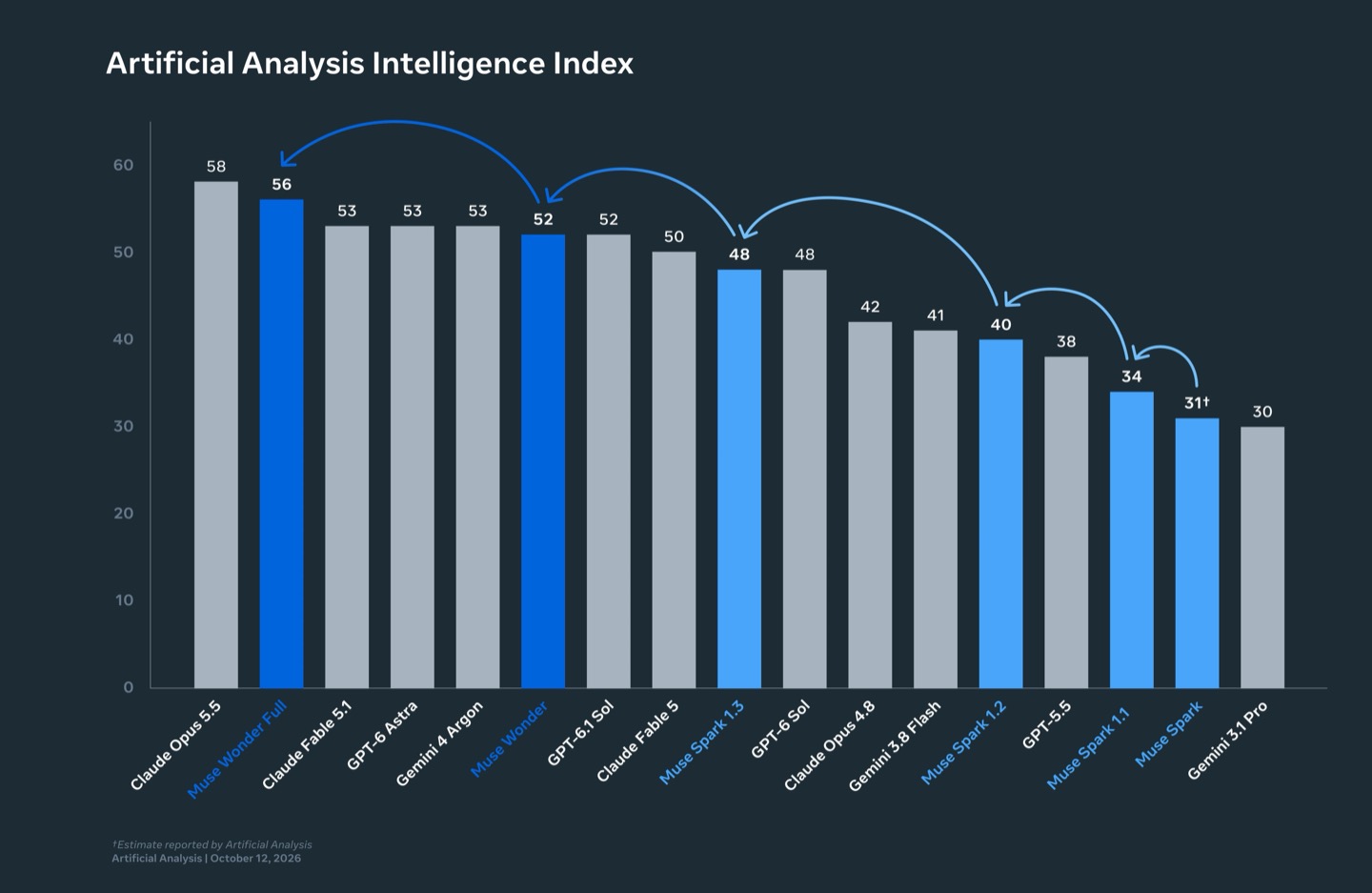
Every other site will repeat the benchmark charts. Here is what they skip: you can't call the strongest model – Wonder Full is subscription-gated and only reachable through Muse Code, so from your own code the ceiling is standard Wonder. On launch-day independent scoring (Artificial Analysis), Claude Opus 5.5 still leads the index (58 vs 56 for Full, 52 for Wonder) – and standard Wonder ties a model that costs six times less per finished task. And the convenient access route has a catch: Muse Code subscriptions default to a mode where Meta trains on your prompts and code. That is what this guide covers.
Source note: specs, scores and prices below come from Meta's research announcement and model card (Oct 12, 2026), Meta's press release and Muse Code documentation. Benchmark numbers are vendor-reported – competitor runs are best-effort in Meta's own words, and the memory/focus tests are Meta-internal. Independent context comes from Artificial Analysis's launch-day index and Claire Vo's How I AI bench. No figure here is an independent VelsTech Solutions benchmark.
Related: we already covered the base it stands on – our Muse personal-agent explainer (Spark 1.3, pricing, the Secure VM) and the Claude Opus 5.5 deep-dive, the model it's measured against most.
The short version: Muse Wonder in 60 seconds
- What: Meta's frontier model family for agents – Muse Wonder (model ID muse-wonder-1.0, in preview) and the stronger Muse Wonder Full. Successor to Muse Spark 1.3 on the scaling ladder; built for long-running personal and professional agent work with Active Memory and Active Focus.
- Price / date: released Oct 12, 2026. API: $4 per million input, $0.20 cached, $20 per million output – identical rates to Claude Opus 5.5, no minimum spend, no long-context premium. Muse Code plans: $5 / $50 / $200 a month; Full sits on the $50 and $200 tiers only.
- Specs: 1,048,576-token context; text, image, video, audio (and PDF) input, text output; plans long tasks and delegates to sub-agents; browser/desktop "computer use".
- Headline claim: state-of-the-art on personal/professional agent, memory and coding benchmarks – Meta's table shows Full at 57.5 on SWE-Marathon (long-running software projects) vs 46.3 for Opus 5.5, and 85.5 on its internal MemoryBench vs 81.5.
- Catch: the flagship isn't on the API; the most impressive rows are Meta-internal tests or uncontrolled third-party harnesses; the independent AA Intelligence Index still has Opus 5.5 first (58 vs 52) – and Wonder costs $4.52 per index task vs $0.72 for GPT-6.1 Sol at the same 52.
- Who: developers running long agent and coding workflows on Meta's stack, and Muse Code Power/Maximum subscribers. For everyone else, the consumer-facing story (Muse app) hasn't fully started yet.
What Muse Wonder actually is
Think of it as the next rung on a ladder Meta has been climbing in public all year: Muse Spark (April 2026) was Superintelligence Labs' first model family; Muse (September 2026) put a personal agent on top of Spark 1.3; and Wonder is the "much larger class of models" Zuckerberg promised would come after. Fourteen months after Meta began rebuilding its AI stack, this is the first release the lab is openly calling frontier-class. Technically it builds on Spark's pretraining and reinforcement-learning work – same API surface, so moving from Spark 1.3 to Wonder is a model-ID change, not a rewrite.
The two headline mechanics are the differentiators. Active Memory carries what matters about you across conversations and actively retrieves the details relevant to the task at hand – so "the agent remembers" becomes a benchmarked property rather than a demo (MemoryBench: 64K–100K-token multi-turn conversations with distractor threads and later corrections that conflict with earlier facts). Active Focus is the persistence trait: when a task hits a blocker, it tries other approaches, asks for clarification, and checks in before important actions – measured on FocusBench (housing, travel, IT and finance tasks with real-world blockers) and sustained execution on SWE-Marathon.
One honesty note on both: these are Meta's internal benchmarks. MemoryBench and FocusBench have no public leaderboard or external replication yet, so treat the memory/focus story as "what Meta measured", not settled science.
Specs at a glance
| Feature | Muse Wonder / Full | Muse Spark 1.3 (previous) |
|---|---|---|
| Model ID | muse-wonder-1.0 (preview); Full has no public ID | muse-spark-1.3 |
| Context | 1,048,576 tokens | 1,048,576 tokens |
| Input → output | text, image, video, audio, PDF → text | text, image, video → text (audio not fully supported) |
| API access | Wonder: yes. Full: never (Muse Code only) | yes |
| API price (per M tokens) | $4 in / $0.20 cached in / $20 out | $1.25 in / $0.15 cached / $4.25 out |
| Weights | proprietary – no open weights announced | Spark Open variant: 816B open-weight |
| Availability | Meta Model API + Muse Code now; Muse app soon (subscribers first) | API, Muse, and open variants |
The honest row is API access: setting Wonder's reasoning effort to max does not select Full – Full is reachable only through the Muse Code command-line agent. The model your application calls is the mid-tier one, permanently. Also note Wonder is a preview model ID; expect iteration.
Pricing: what it actually costs
| Route | Price | Model you get | Training on your data? |
|---|---|---|---|
| Meta Model API | $4 in / $0.20 cached / $20 out per M tokens; no minimum spend | Wonder only | No – Standard mode only |
| Muse Code – Everyday | $5/month (10–50 prompts per 5 h) | Wonder | Contributor mode by default |
| Muse Code – Power | $50/month | Wonder + Full | Contributor mode by default |
| Muse Code – Maximum | $200/month | Wonder + Full | Contributor mode by default |
| Muse app (consumer) | $20 or $100/month | Wonder "soon", subscribers first | conversations not used for ads, per Meta |
- The cliff/catch: equal token rates are not equal bills. In Artificial Analysis's index runs, Wonder cost $4.52 per finished task against $5.98 for Opus 5.5 (which scores six points higher) and $0.72 for GPT-6.1 Sol (which scores the same 52). The Muse models produce far more output tokens than the suite's median (130–140M vs 85–88M) because reasoning and agent steps all bill as output. Your workload decides the real number – measure it.
- Concrete: a ten-step coding agent that reads ~50K tokens and writes ~8K per step is roughly 500K in + 80K out per task: ~$2.00 + $1.60 ≈ $3.60 with Wonder – and heavy prompt caching at $0.20/M pulls the repeated input part toward zero. Run your own numbers in our API cost calculator.
- The data switch: on the API your content is not used for training (Standard mode). Muse Code subscriptions default to Contributor mode – more usage in exchange for Meta training on your prompts, code and files. It can be switched off in settings; if you're coding anything sensitive, do that first.
- Limits: muse-wonder-1.0 is capped at 3,000 requests and 4M tokens per minute, shared across all keys of a team.
How it compares
Meta's own table, max reasoning effort on every row (as compiled from the launch materials):
| Benchmark (what it tests) | Wonder Full | Wonder | Claude Opus 5.5 | GPT-6 Astra |
|---|---|---|---|---|
| SWE-Marathon (long software projects) | 57.5 (xhigh) | 53.1 | 46.3 | 42.5 |
| DeepSWE v1.1 (long-horizon coding) | 79.0 | 78.8 | 74.2 | 74.1 |
| Harvey LAB-AA v1.1 (legal agent, strict pass) | 13.1 | 10.0 | 4.2 | 8.6 |
| AutomationBench-AA (business workflows) | 45.4 | 39.1 | 41.2 | 41.6 |
| ProgramBench (program from scratch) | 59.0 | 50.0 | 70.5 | 52.5 |
| Terminal-Bench 4.0 (terminal coding) | 57.1 | 52.0 | 59.6 | 59.1 |
| HealthBench Pro (health questions) | 62.3 | 60.5 | 65.6 | 65.3 |
Read honestly: Full leads where tasks stretch long – multi-day software projects, strict legal-agent work (Harvey LAB-AA's hallucination-to-zero grading: an 13.1% strict pass is the best any tested model managed), and business workflows. Opus 5.5 keeps the lead on from-scratch programming, terminal coding and health questions, and computer use (OSWorld V2.1) also favors Anthropic's model in Meta's charts. Standard Wonder sits mid-pack on most rows.
Meta's methodology caveats matter: competitor runs are "best-effort", SWE-Marathon is not a controlled comparison (Full ran at xhigh effort; the Astra and Fable 5.1 rows come from Codex and Claude Code runs), no row carries confidence intervals, and where a third-party result exists Meta takes it – otherwise the highest of its own run, a self-report, or the official leaderboard.
On the independent side, Artificial Analysis's Intelligence Index (v4.3.2, launch day) ranks it this way: Opus 5.5 58 · Wonder Full 56 · GPT-6 Astra 53 · Gemini 4 Argon 53 · Muse Wonder 52 · GPT-6.1 Sol 52 · Muse Spark 1.3 48. Independent testing by Claire Vo's How I AI bench (~20 tasks across prototyping, coding, writing and design) broadly agrees with the agentic framing: Wonder ranked first on three agentic tasks and was fast on one-shot work, but trailed Opus 5.5, Astra and Fable on design-adjacent output (SVG illustration, short-form video) and ran slow on long agent tasks.
The generalization argument – Meta's answer to "benchmaxxing"
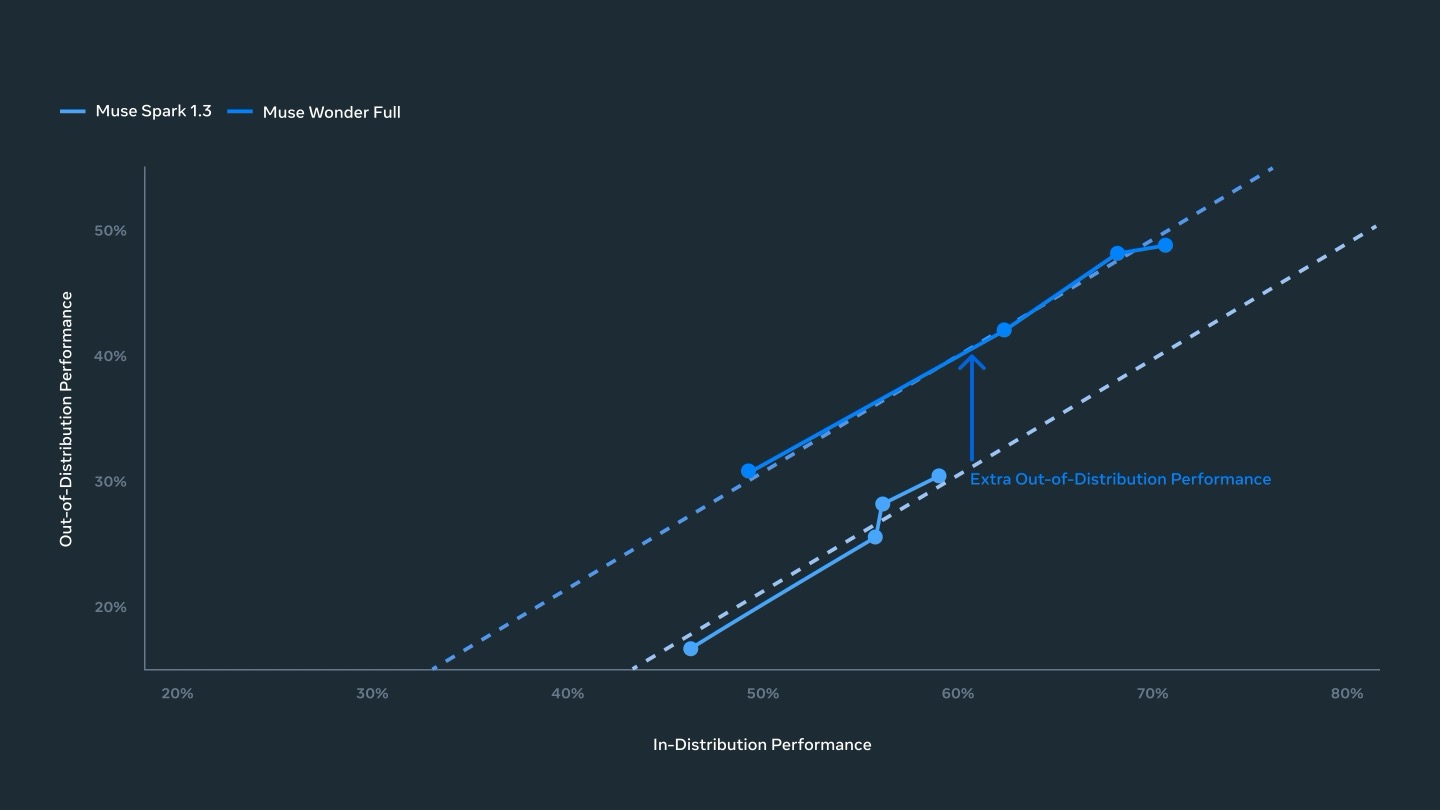
The research post includes something rarer than a benchmark table: an argument about why the scores should be believed. Frontier models get accused of two things – benchmaxxing (overfitting to known tests) and what the post calls the "big model smell" (scores tracking parameter count rather than real capability). Meta's counter is a test-time-compute scaling analysis: Wonder Full scores above the OOD (out-of-distribution) trend line that Spark 1.3 established on held-out task families – the claim being the gains come from better training, not from memorizing this year's tests.
It's a self-graded argument about their own model family – but it's the right kind of chart to publish, and it predicts a testable outcome: Wonder-class performance should survive contact with unfamiliar task types (watch the independent benches over the coming months).
Safety: what the model card actually discloses
- The headline admission: without mitigations, Meta does not rule out that Wonder Full reaches the high-risk threshold in the Chemical & Biological domain under its Superintelligence Scaling Framework. With safety post-training and system-level classifiers, residual risk is assessed "moderate or lower" across cyber, CBRN and loss-of-control – the basis for the deploy decision.
- Cyber capability: CyberGym 88.4%, ExploitBench 58.9%, and ExploitGym 92 flags captured – of which Meta discloses only 21 used the intended vulnerability (71 came through unintended bugs). That footnote is unusually candid and worth reading twice: the model is both a useful security tool and a creative attacker.
- Refusal robustness: 98.7% on SecureBio's BioTIER (English), 100% on internal chemistry-refusal sets, and attack success rates as low as 0.8–2.3% on CyberBench/PolyGuard (9% on RedCode). MASK honesty-under-pressure: 87.3%; Agentic Misalignment: 0%.
- Privacy behavior: in Meta's personal-data tests, Full mishandled private information in 2.2% of cases (Wonder 3.4%; GPT-6 Astra 4.6%; Fable 5.1 6.8%). Relevant when a personal agent reads your mail, calendar and documents.
- Still missing: the full safety report ("available soon"), parameter counts, and any open-weights plan. The model card also flags 3D/spatial reasoning as a known weakness and says the model is not intended for under-18s.
The India angle
- Access: the Meta Model API and Muse Code work from India (billing in USD; no INR pricing published). The consumer-facing Muse app remains US-only as of its September launch, so the "personal agent" experience isn't officially here yet – Wonder in Muse will roll out to subscribers first, region plans unannounced.
- Cost in rupee terms: Muse Code Power at $50/month is roughly ₹4,300–4,500/month, Maximum at $200 about ₹17,000–18,000/month (indicative, at ~₹85–88 per dollar). API spending is metered in USD on your card's forex rates.
- The local comparison: $200/month is the EMI on a decent GPU. If your workload is high-volume coding agents, our local-vs-cloud cost math and under-₹50,000 GPU guide cover when a one-time rig beats per-token billing – Wonder's $4/$20 rates make cloud agents noticeably pricier than Spark 1.3 was.
Which to pick
- Pick Wonder if: you run long agent or coding workflows and want a frontier agentic model with per-token billing. Prototype on multi-hour runs where memory/focus actually matter; keep Spark 1.3 for high-volume or latency-sensitive steps – that's Meta's own advice, and the 3× token premium makes it sensible.
- Pick Full if: your work is long-running software projects and you're already a Muse Code Power/Maximum subscriber. Turn Contributor mode off before pointing it at work code.
- Consider instead: Claude Opus 5.5 if you need the strongest all-rounder today (it still tops the AA index and the from-scratch/terminal/health rows); GPT-6.1 Sol if cost dominates (same independent score at $0.72/task); GPT-6 Astra as the OpenAI alternative.
What this means if you run local AI
Nothing ships locally – Wonder is proprietary, no weights, no quantized builds, and the model card lists quantization sensitivity as a caveat rather than a release plan. The interesting signal is the shape of the ladder: Meta keeps one rung open (Spark Open 816B, Muse Glimmer) while the frontier rung stays closed. The mechanics pioneered here – cross-session memory retrieval, sub-agent delegation, check-in-before-acting behavior – are exactly the features the local and open-source stacks will spend the next two quarters copying, since agent harnesses (llama.cpp-based tools included) can implement them at the harness layer even with mid-size models.
Practical takeaway for local users: price your agent workloads before assuming cloud is cheaper. At Wonder's rates, a coding agent chewing 500K input tokens per task pays for a used GPU surprisingly fast – our break-even calculator guide and local-AI getting-started guide are the two bookmarks to keep ready.
Bottom line
Muse Wonder is Meta's first credible frontier claim since the Superintelligence Labs reboot – and the access design tells you how Meta sees the market: the model your code can call is the mid-tier one at Opus-level token rates, while the flagship lives behind a subscription that trains on your data by default. The agentic mechanics (Active Memory, Active Focus) are real, benchmarked product features even if their tests are self-graded. If you build agents, run the numbers on your own workload – the capability jump is real, and so is the bill.
Sources
- Meta AI Research: Muse Wonder – A Frontier Model For Personal & Professional AI Agents (Oct 12, 2026)
- Meta: Muse Wonder model card (evaluations, safety assessments, limitations)
- Meta Newsroom: Introducing Muse Wonder and Muse Wonder Full (Oct 12, 2026)
- Meta Model API docs: Muse Code subscriptions and modes
- Artificial Analysis: Muse Wonder launch-day Intelligence Index scores
- Claire Vo (How I AI): independent ~20-task first-look bench (Oct 14, 2026)
- Our Muse personal-agent explainer (Spark 1.3, Secure VM, pricing)
Content and image notice: this is VelsTech Solutions' own summary and analysis of the cited sources – no article text is reproduced wholesale, benchmark figures are attributed to their publishers (Meta for its own tables, Artificial Analysis for the independent index), and all capability claims are vendor-reported unless stated otherwise. The images are © Meta Platforms, Inc., used for editorial coverage with the credit kept in each figcaption (see also img/muse-wonder/NOTICE.md). Muse, Muse Wonder, Meta and related marks are trademarks of Meta Platforms, Inc.; other model and company names are trademarks of their respective owners.
FAQ
What is Muse Wonder?
Muse Wonder is Meta Superintelligence Labs' frontier model family for personal and professional agents, released October 12, 2026. It comes in two tiers – Muse Wonder (model ID muse-wonder-1.0, preview) and the stronger Muse Wonder Full – and succeeds Muse Spark 1.3 on the scaling ladder. It runs on a 1-million-token context, accepts text, images, video and audio, and was trained at Meta's Prometheus data center. Its defining features are Active Memory (context carried and retrieved across conversations) and Active Focus (persisting through blockers with clarifications and check-ins).
How much does Muse Wonder cost?
On the Meta Model API: $4 per million input tokens, $0.20 cached input, $20 per million output tokens – the same rates as Claude Opus 5.5, with no minimum spend. Muse Code plans run $5 (Everyday, includes Wonder), $50 (Power) and $200 (Maximum) a month; Wonder Full is included only on the $50 and $200 tiers. The Muse consumer app is $20 or $100 a month, with Wonder rolling out to subscribers first.
What's the difference between Muse Wonder and Muse Wonder Full?
Access and capability. Wonder is callable from your code via the API and sits on every Muse Code plan; Full exists only inside Muse Code on the $50/$200 plans and has no API access at all. In Meta's tests Full leads on long software projects (SWE-Marathon 57.5 vs 53.1), strict legal-agent work (Harvey LAB-AA 13.1 vs 10.0) and business workflows (AutomationBench-AA 45.4 vs 39.1); standard Wonder trails Claude Opus 5.5 on from-scratch programming (ProgramBench 50.0 vs 70.5), terminal coding (52.0 vs 59.6) and health questions (60.5 vs 65.6). Independently (Artificial Analysis), Full scores 56 and Wonder 52 against Opus 5.5's 58.
What are Active Memory and Active Focus?
Active Memory is Meta's mechanism for carrying important context about you across conversations and retrieving what's relevant to the current task; on its internal MemoryBench (64K–100K-token conversations with distractors and corrections), Wonder scores 85.6 and Full 85.5 against 81.5 for Opus 5.5 and 81.4 for GPT-6 Astra. Active Focus is sustained goal pursuit – trying alternatives when blocked, asking for clarification, checking in before important actions; on internal FocusBench, Full scores 54.2% vs 47.7% for Astra, 45.8% for Opus 5.5 and 44.9% for Wonder. Both benchmarks are Meta-internal, with no independent replication yet.
Does Meta train on my data?
It depends on the route. The Meta Model API runs Wonder in Standard mode only, where Meta says your content is not used for training. Muse Code subscriptions – the only way to reach Wonder Full – default to Contributor mode, which grants more usage in exchange for Meta training future models on your prompts, code and files; it can be turned off in settings at any time, which is advisable before sending proprietary code.
Can I run Muse Wonder locally, or use it from India?
Not locally – the weights are proprietary with no open release announced; Meta's open rungs are Muse Spark Open (816B, open-weight) and Muse Glimmer (30B, local agents). From India, the Meta Model API and Muse Code are usable (USD billing, no INR pricing), while the consumer Muse app remains US-only as of launch. Muse Code's $50 and $200 plans map to roughly ₹4,400 and ₹17,500 a month (indicative).